Pharmacy Technician Certification Online: Start Your Healthcare Career
A Practical Guide to Online Pharmacy Technician Training and Certification

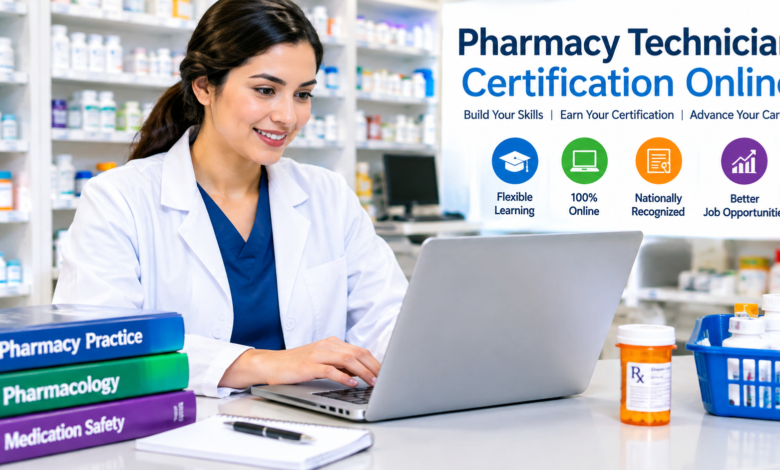
Introduction
A career in pharmacy can offer meaningful work, practical responsibilities, and opportunities to grow within the healthcare industry. For people interested in entering this field without spending several years earning a traditional degree, Pharmacy Technician Certification Online programs can provide a flexible way to learn essential skills and prepare for professional certification.
Pharmacy technicians work alongside pharmacists and other healthcare professionals to support prescription processing, medication preparation, inventory management, patient service, and other pharmacy operations. In the United States, requirements vary by state, so students should always check the rules of the state where they plan to work.
What Is a Pharmacy Technician?
A pharmacy technician is a healthcare professional who assists pharmacists with many day-to-day pharmacy activities. Depending on the workplace and state regulations, responsibilities can include receiving prescription information, preparing medications, maintaining records, managing inventory, processing insurance information, and communicating with patients.
Pharmacy technicians may work in community pharmacies, hospitals, grocery stores, drug retailers, and other healthcare settings. According to the U.S. Bureau of Labor Statistics, pharmacy technicians held approximately 471,200 jobs in 2025.
The exact responsibilities of a technician depend on the employer, training, certification, and applicable state regulations.
What Is Pharmacy Technician Certification Online?
Pharmacy Technician Certification Online generally refers to an online education or preparation program designed to teach the knowledge and skills needed for pharmacy technician work and certification examinations.
Online learning can include subjects such as:
- Pharmacy calculations
- Medication names and classifications
- Prescription processing
- Pharmacy law and regulations
- Medication safety
- Pharmacy terminology
- Inventory procedures
- Dosage forms and routes of administration
- Patient and prescription information
- Order entry and processing
A good program should clearly explain what credential or examination it prepares students for and whether the program meets the eligibility requirements of the relevant certification organization.
Why Choose Online Pharmacy Technician Training?
Online education can be attractive to students who need flexibility. Instead of attending every class at a physical campus, learners can often study lessons and complete assignments through an online learning platform.
This format may be particularly useful for students balancing school, family responsibilities, or other commitments. However, online does not necessarily mean that every part of pharmacy technician preparation can be completed remotely. Some programs include practical training or an externship, and state requirements can differ.
The U.S. Bureau of Labor Statistics notes that pharmacy technicians may enter the occupation through on-the-job training or postsecondary pharmacy technology programs. Programs may cover pharmacy arithmetic, recordkeeping, medication dispensing, pharmacy law and ethics, medication names, uses, and doses.
Understanding Pharmacy Technician Certification
Two major certification pathways in the United States include the Pharmacy Technician Certification Board (PTCB) Certified Pharmacy Technician credential and the National Healthcareer Association’s Certified Pharmacy Technician credential.
For PTCB certification, candidates must meet eligibility requirements and pass the Pharmacy Technician Certification Exam, known as the PTCE. PTCB currently lists two main eligibility pathways: completion of a PTCB-recognized education or training program, or qualifying pharmacy technician work experience of at least 500 hours.
The PTCE currently contains 90 multiple-choice questions, including 80 scored questions and 10 unscored questions. PTCB states that the certification application and examination fee is $129.
The National Healthcareer Association offers the ExCPT examination for its Certified Pharmacy Technician credential. NHA lists eligibility routes involving a high school diploma or equivalent plus completion of qualifying pharmacy technician training, or relevant supervised work experience.
Because requirements can change, students should confirm current eligibility rules directly with the certification organization before enrolling in a program.
What Do Online Programs Teach?
A strong pharmacy technician course should provide a foundation that matches real pharmacy responsibilities and the relevant certification examination.
The updated PTCB PTCE content outline, effective January 2026, covers four major knowledge areas. Medications represent 35% of the examination content, while other areas include federal requirements, patient safety and quality assurance, and order entry and processing.
Students should therefore expect to study more than medication names. They also need to understand accuracy, safety, pharmacy regulations, calculations, prescription processing, and professional responsibilities.
Practice questions, simulated pharmacy tasks, flashcards, quizzes, and examination preparation can help students reinforce what they learn.
How Long Does Certification Take?
There is no single timeline that applies to every student. The length of an online program depends on its curriculum, schedule, learning format, and whether it includes practical training.
Some students may choose a short certificate program, while others may complete a longer pharmacy technology program through a college or vocational school.
The BLS reports that some postsecondary pharmacy technician programs award a certificate in one year or less, while other programs can lead to an associate degree.
Before enrolling, review the program’s total duration, required coursework, practical experience requirements, examination preparation, and certification eligibility.
How to Choose an Online Certification Program
Choosing an online program requires more than comparing tuition prices. Look for a program that clearly explains its curriculum and certification pathway.
Consider these factors:
Accreditation and Recognition
If your goal is PTCB certification, check whether the education program is PTCB-recognized. PTCB maintains a directory that allows students to search for recognized education and training programs, including programs categorized as online or distance learning.
Course Content
Review the subjects covered by the program. The curriculum should prepare students for important pharmacy technician knowledge areas rather than focusing only on memorization.
Practical Training
Ask whether the program includes an externship, laboratory activities, or another form of hands-on experience. Practical exposure can help learners understand how pharmacy operations work in real settings.
Exam Preparation
Look for programs that provide practice examinations, study resources, and clear information about the certification exam for which they prepare students.
State Requirements
State pharmacy boards may have different registration, licensing, education, examination, or certification requirements. The BLS emphasizes that most states regulate pharmacy technicians in some way.
Career Outlook for Pharmacy Technicians
Pharmacy technicians remain an important part of pharmacy operations. The BLS projects employment to grow 6% from 2025 to 2035, with approximately 44,700 openings expected each year on average during that period.
The BLS reported a median annual wage of $45,750 for pharmacy technicians in May 2025. Actual earnings can vary considerably according to location, employer, experience, certification, and work setting.
Hospitals, pharmacies, grocery retailers, general merchandise stores, and ambulatory healthcare services employ pharmacy technicians.
Skills Needed for Success
Certification is important, but successful pharmacy technicians also need strong workplace skills. Accuracy is especially important because technicians handle medication-related information and pharmacy records.
Useful skills include:
- Attention to detail
- Basic mathematics
- Organization
- Computer skills
- Communication
- Customer service
- Time management
- Ability to follow procedures
- Teamwork
- Commitment to medication safety
Developing these skills during training can help students become more prepared for the workplace.
Final Thoughts
Pharmacy Technician Certification Online can be a convenient starting point for people interested in pharmacy technology and healthcare support. Online education can provide flexible learning while helping students build knowledge in medications, pharmacy calculations, safety, regulations, and prescription processing.
However, certification is only one part of becoming a pharmacy technician. Students should verify state requirements, choose appropriate training, understand the eligibility rules of their preferred certification organization, and prepare carefully for the required examination.
With the right education and practical preparation, aspiring pharmacy technicians can build a foundation for entering a healthcare environment and continuing their professional development.




